Kayıtlar

#communication etiketine sahip yayınlar gösteriliyor

Week 13 - Augmented Reality in Language Learning

Resim
 We started our lesson with pictures from Gökan Hoca's previous classes and talked about VR. Then we went on with the difference between AR and VR; apparently augmented reality, overlays digital images onto your view of the real world, often through a smartphone while virtual reality primarily uses a headset to form an immersive 3D experience.  After that, we discussed the places that AR is used. Some of which are; - Education - STEM - Gaming (e.g. Pokemon GO) [Picture 1] - Job Training - Furniture display (e.g. IKEA) [Picture 2]  - Navigation (e.g. Google Maps) [Picture 3], etc.  Then Ayşe Sude said that one of the negative aspects of AR is that it does not seem real, it's way too animatic. Melis also reminded us that some people were injured while playing Pokemon GO; therefore, physical safety could also be an issue. From there on, we learned that AR has 3 types of applications; Image-based, Creation-based, and Markerless . Image-based: Using AR by scanning QR cod...
Week 10 - Gamification

Resim
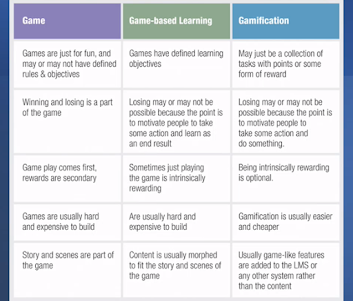
 We started this week's lesson with a Minecraft background by Mr. Karacan 😸. The first question of the lesson was ' What is your favorite game? ' but I missed that part; therefore I'll answer it here, it is Outlast (and maybe Resident Evil)! I'm a huuuge admirer of horror games.👹  After, we learned the differences between games, game-based learning, and gamification. Games are, as we all know, programs that are produced to make people have fun. Game-based learning is providing education by using games and fun activities but in this way of learning, apparently, the whole content is based on the game. Meaning that the learning is guided by the game . This is the main feature that distinguishes gamification from game-based learning. The game does not direct the whole content, the teacher does. He/she gamifies an element but it does not take place the whole semester. Then Mr. Karacan showed us a list [Picture 1] that contained more detailed differences between the ter...

Week 9 - Mobile-assisted Language Learning

Resim
 In this week's lesson, we talked about MALL , an abbreviation for  Mobile-assisted Language Learning . The meaning of this phrase is receiving education from small mobile devices/smartphones.  This way of learning has many redeeming features and positive gainings. The conveniences are, according to Agnes Kukulska-Humme and Olga Viberg (2018) , being accessible anywhere and anytime, personalization, active participation, peer-coaching, etc. It also helps with motivation and enjoyment as well as the reduction of anxiety during language classes.  However, this learning form has negative aspects too. Students are more likely to get distracted by their phones, have safety concerns, or face technical issues; therefore, decreasing the chances of receiving high-quality lessons. Then we mentioned applications/websites to use in order to help the learner improve in speaking skills. Some of which are Duolingo, Voicethread, Twitter, video editing apps, WhatsApp , etc. Using th...

Week 8 - Learning Management Systems

Resim
 In this week's lesson our topic was LMS , an abbreviation for Learning Management Systems . Such systems help teachers in managing class, homeworks, reports, etc. There are many systems teachers can use as a management tool. The websites/systems we mentioned in the class are below; Microsoft Teams: An system which has features like live meeting, chatting, assigning works, pairing into groups, grading, etc. Perculus: A system that is known for being more private; therefore, safer than other systems. However, it is not applicable because of the lack of features. Blackboard: An education based systems with many features. It is similar to Teams but this one can be accepted more useful due to the convenience of it. It allows teachers to download documents easily. Other striking features are time tracking, various testing types (fill-in-the-blanks, open-ended, multiple choice, etc.), rooms, etc. Edmodo: Guess what? Another education based system 😁 It offers features like online classes...

Week 7 - Presentation Systems & Platforms

Resim
 We started our lesson with the daily moods of our classmates. Then we went on with today's topic: Systems that can be used while giving a presentation and how to make our presentations more interactive. We checked out a few websites to use in order to improve our presentations. The websites are below; Nearpod: A n interactive presentation website that has VR (360 ° Map), voting, pie chart,   true/false activity, drawing, and  collaborative board features. Mentimeter: Another interactive website with many features like interactive polls, quizzes, Q&A, and word cloud. Hypersay: Again, an interactive website 😀. The site has a chatbox, question tab, and clapping feature. Slido: A presentation website that has features like polling, Q&A, multiple choice quiz, rating, ranking, etc. Canva: A website that has informative graphic templates about many topics. Postermywall: Another website with many templates that can be used in order to improve presentations visually. Pik...

Week 6 - Technologies to Practice Oral Communication Skills

Resim
We started our lesson by recalling what we did in previous weeks; technologies to use while practicing reading (e.g. Storyweaver, CommonLit ), writing (e.g. Padlet, OneNote ), vocabulary (e.g. Kahoot, Quizziz ), etc. Then went on with this week's topic: Oral Communication Skills and How to Develop them with Technology During our lesson, we observed many websites. Some of which are below; - Google Podcasts: The website where you can try Google's feature with thousands of podcasts - Castos: A website to produce your own podcast or listen to one - Voki: A website where the narrator can form a character and make it talk - Powtoon: Website to generate animations - Vyond: Website to make animation videos - EdPuzzle: Website to prepare interactive videos - YouGlish: Website that shows the word used in context (in videos) - VoScreen: Website to study language by doing activities from movie/series scenes. Example of an exercise is down below [Picture 5] - Elllo: Website that give...